


Welcome back, knowledge seekers. It’s time for another installment of our Strategic Carding series. If you’ve been following along, you know we’re not here to feed you step-by-step nonsense. This series is about reprogramming your brain to think like a carding master, not some button-mashing monkey.
We’ve covered the balance between value and risk, and now we’re diving into something even more fundamental: knowledge acquisition. Because let’s face it, in this game, information is more valuable than the cards you burn. What better way to improve your carding game than to become a damn knowledge sponge?

In this article, we’re going to take a detailed look at how to effectively acquire and retain information. We’re talking about turning your brain from a leaky bucket into a steel trap that catches every bit of useful information.
So grab your notebooks, it’s time to learn.
Knowledge
Ever since I started writing on this forum, I’ve been bombarded with questions. “How do you know all this?” “Where can I read more about this?” “What’s the secret to your great brain power?” And the answer is always the same: through experience and research.
Now, when it comes to experience, there’s nothing you can do except try and fail. It’s like learning to ride a bike – you’ll eat shit a few times before you can do a wheelie. But every time you fall on your face, you’ll learn something new. Maybe you’ll learn which proxies are hot garbage, or which carding shops are more reliable than your ex’s period. The point is, you have to get your hands dirty.
But what we can focus on more, especially if you’re lost in the sea of jargon, methods, and crap that comes with carding, is gaining knowledge through research. Yes, I know, it sounds like you’re back in school. But trust me, this is not your high school history lesson — this shit will not only make you rich, it will also keep you out of jail.
The fact remains: the internet is like a giant digital landfill. For every grain of gold, there’s a mountain of junk. Reading everything and testing every method out there is not only impossible, it’s counterproductive as hell. You’ll have better luck trying to empty the ocean with a teaspoon.
You need to structure your knowledge sources and have a reliable way to prioritize legitimate information from junk. You wouldn’t want to use an Apple carding method written by some random idiot from 2019, would you?
So how do we separate the gold from the junk? How do we create a knowledge base that will be more reliable than your alibi when the feds come knocking? Stay tuned, because we are about to turn your brain into a carding encyclopedia.
How knowledge spreads
In hacker circles, there is a concept called 0days — unpatched exploits known only to a select few. Carding works on a similar principle. We are all just digital pirates exploiting the system’s weaknesses.
The carding knowledge food chain works like this:
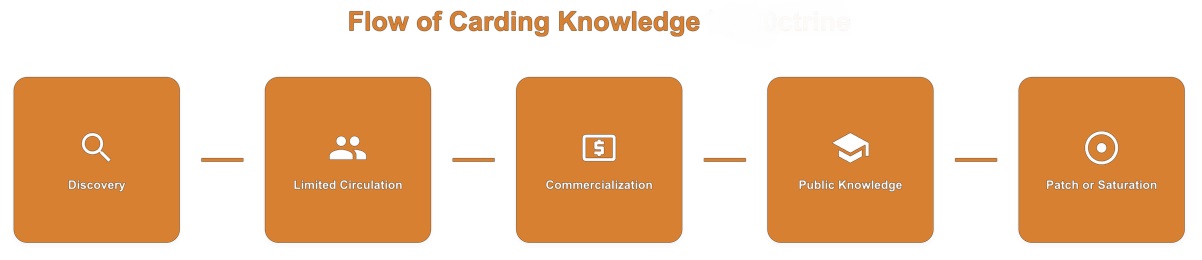
Discovery
Some smart guy comes up with a new method. Maybe it’s a way to bypass Amazon’s security, a golden BIN that works like a charm, or a foolproof cash-out technique. This is 0day carding — pure, uncut knowledge that prints money fast.
↓
Limited Edition
The discoverer either keeps it to himself (selfish jerk) or shares it with his inner circle. This is where the real money is made. Chinese carders are notorious for this. If you’re not completely illiterate and can use a translator, breaking into Chinese Telegram groups or forums is like hitting the knowledge jackpot. These bastards know carding secrets that us mere mortals can only dream of.
↓
Commercialization
As word spreads, some enterprising jerk monetizes it. Keep an eye out for “$1000 for the best carding method” forum posts. ↓
Public Knowledge
Eventually, the method gets out. Maybe someone was careless, or a buyer decided to share. Once it's out there, it spreads faster than an STD in a college dorm.
↓
Patch or Saturation
One of two things happens next. Either the target site patches the vulnerability, or so many idiots use the method that it becomes useless.
That’s why, when I retired, I made it my mission to share my years of knowledge with as many people as possible. Knowledge should be free, and new carders deserve a chance to earn their money.
But knowing how information flows is just the first step. The real challenge is putting yourself in the position to catch that knowledge before it becomes common garbage. That’s where the real money is.
The Ladder
To climb the ladder of knowledge, you have to hustle like your freedom depends on it — because in this game, it damn well does. Work the web, but don’t just leech. Share your own discoveries after you’ve squeezed them for all they’re worth. Stay active in the community and sharpen your bullshit detector — learn to read between the lines on forums. And don’t be afraid to invest in knowledge. Sometimes shelling out for a method can pay off if you act fast and use it before everyone and their grandmother finds out; And it only works if you have the right connections.
The key is to be at the source of the flow, not downstream with all the other idiots salivating over a four-year-old PDF.
In this game, knowledge doesn’t trickle down — it damn well flows. But by the time it reaches the masses, it’s often diluted or outdated. Your target is straight from the firehose of carding innovation.
The next time you see a technique go public, don’t jump on the bandwagon. Ask yourself, “How can I get closer to where this came from?” That’s how you stay ahead. Because in carding, as in life, it’s not what you know, it’s how fast you learn it.

Secondary Sources
First-hand information is gold, but sometimes you need to turn to publicly available guides – maybe the site you’re targeting hasn’t updated its security system in a while, or the specific knowledge you want to learn about BIN isn’t that hard to find.
When you’re looking for specific methods, publicly available guides can be a real treasure trove. Most of the stupid guides sold on public Telegram are already in the public domain.
Here’s a dirty little secret about carding guides: once they’re publicly available, they’re free forever. That “exclusive” scam Bible some scumbag is selling for $50? It’s floating around the internet, free to grab. You just have to know where to look.
Most of these guides end up as PDFs and are distributed as digital STDs. Some dumb carder shares it with his group, another uploads it to his cloud storage, and before you know it, these files are indexed by specialized search engines. It’s like a twisted version of academic publishing, but instead of peer-reviewed journals, we have step-by-step guides on how to screw up Amazon.
PDF search engines are your best friends here.
They crawl through academic databases, file-sharing sites, and forgotten corners of the web, indexing every bit of carding knowledge that’s slipped through the cracks. It’s great, really—the same technology that was designed to help college students find academic papers now serves up cheating guides on a silver platter.
Here are some of the best hunting grounds:
Now you might be wondering, “Why are there carding guides on educational platforms?” It’s simple: many carders are broke students. They upload these guides to these sites, either to share them with other scammers or simply because they are too stupid to realize that they are leaving a permanent digital footprint. Their cloud storage becomes our carding library.
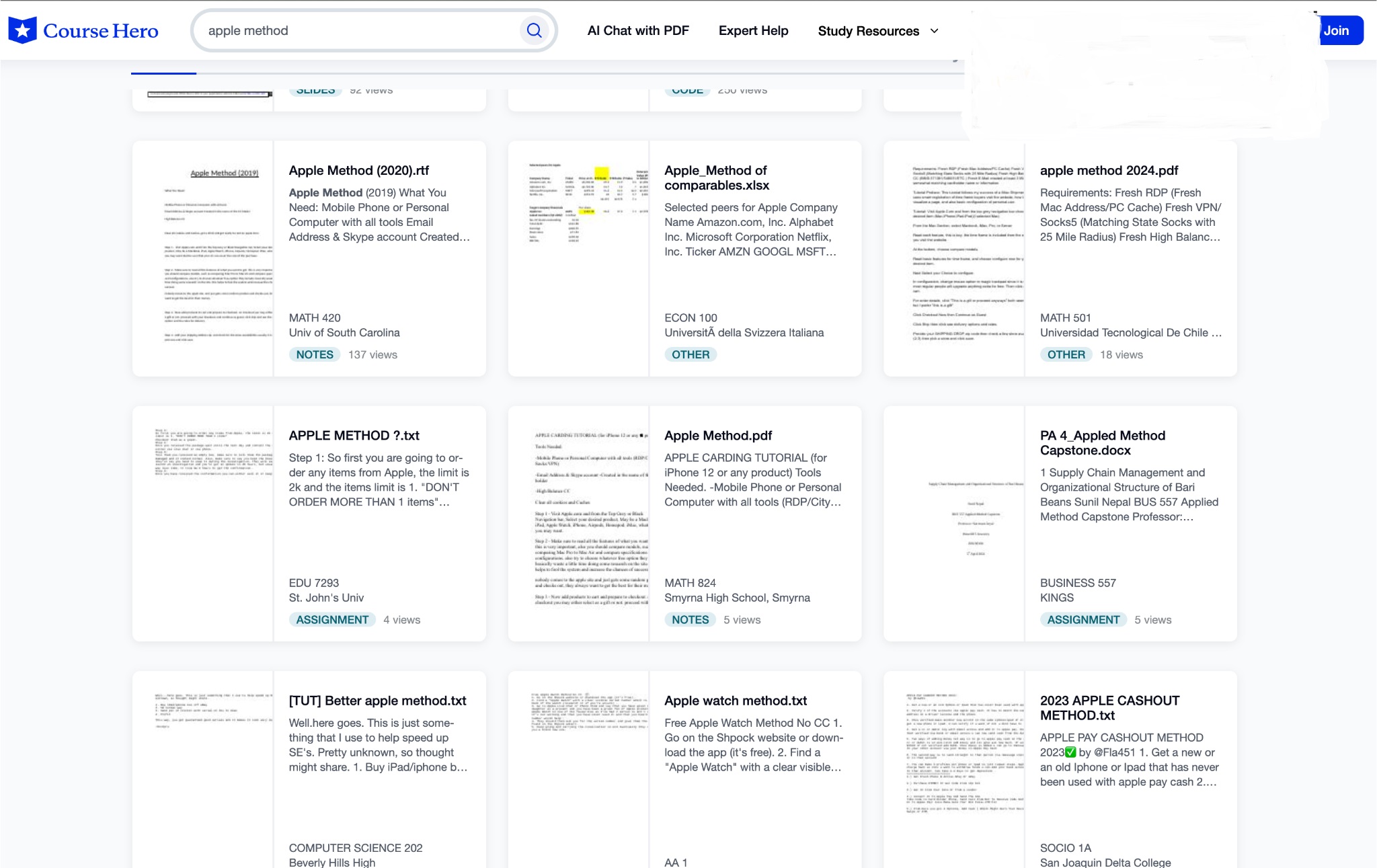
The key is cross-referencing. If you see the same method appearing in multiple sources, especially with recent dates, you may be onto something real.
Remember, though, these are secondary sources. They’re good for filling in gaps in your knowledge or getting ideas, but they’re not cutting edge. By the time a method hits these platforms, it’s already on its way to burning out. Use these guides to lay your foundation, but don’t expect to get rich.
The real value in these secondary sources is the principles. Don’t just memorize the steps — understand how to do it. That way, when the method gets fixed, you can adjust it instead of being left with nothing.
Your Own Library
Now that you know how to find information, it’s time to hoard it like a freaking dragon. Forget those messy folders on your desktop — we’re talking a full-fledged knowledge management system. My pick? Obsidian. It’s like a second brain, but without the hangover.
Here's how I do it: Every new method, trick, or piece of information goes straight into Obsidian. But I don't just dump crap in there. I break it down, tag it, and link it to other things. So when I'm deep in a carding session and hit a snag, I don't waste time scrolling through old chats. It's all right there, ready to go.
Take the new 3D Secure bypass.
I don't just copy the steps. I break them down:
It's not just collecting information - it's creating a fucking ecosystem of carding knowledge.
The real magic is the carding patterns. When everything is laid out, you'll see connections that others miss. Maybe two random tricks have something in common. Boom - you just created a new method.
Don't get hung up on pure carding either. Social engineering method? Keep it. Bank fraud procedures? Go for it. You never know when that random crap might net you your next big score.
You can even link related things together in one big graphical representation, that way you can quickly jump to related ideas and methods that might work with the site you're trying to hit.

Just encrypt that shit tight. Your digital vault becoming Exhibit A is a fast track to becoming someone’s prison bitch.
Wrap that shit up
Look, we’ve covered a lot here. From how knowledge flows in our little world to building your own carding library. Information is your lifeline in this game. It’s not just about the latest techniques or the hottest BIN. It’s about knowing how to find, process, and apply that knowledge faster and better than the next guy.
Remember, every piece of information you gather, every connection you make, is another tool in your arsenal. In a world where techniques burn through faster than a snitch in prison, adaptability is king. And that comes with understanding the principles behind tricks, not just memorizing the steps.
So get out there and start building your knowledge empire. Network, research, organize, and most importantly, think. Because in this game, the deadliest weapon isn't the stolen map, it's the brains behind the operation.
Now stop reading and start doing.
We’ve covered the balance between value and risk, and now we’re diving into something even more fundamental: knowledge acquisition. Because let’s face it, in this game, information is more valuable than the cards you burn. What better way to improve your carding game than to become a damn knowledge sponge?
In this article, we’re going to take a detailed look at how to effectively acquire and retain information. We’re talking about turning your brain from a leaky bucket into a steel trap that catches every bit of useful information.
So grab your notebooks, it’s time to learn.
Knowledge
Ever since I started writing on this forum, I’ve been bombarded with questions. “How do you know all this?” “Where can I read more about this?” “What’s the secret to your great brain power?” And the answer is always the same: through experience and research.
Now, when it comes to experience, there’s nothing you can do except try and fail. It’s like learning to ride a bike – you’ll eat shit a few times before you can do a wheelie. But every time you fall on your face, you’ll learn something new. Maybe you’ll learn which proxies are hot garbage, or which carding shops are more reliable than your ex’s period. The point is, you have to get your hands dirty.
But what we can focus on more, especially if you’re lost in the sea of jargon, methods, and crap that comes with carding, is gaining knowledge through research. Yes, I know, it sounds like you’re back in school. But trust me, this is not your high school history lesson — this shit will not only make you rich, it will also keep you out of jail.
The fact remains: the internet is like a giant digital landfill. For every grain of gold, there’s a mountain of junk. Reading everything and testing every method out there is not only impossible, it’s counterproductive as hell. You’ll have better luck trying to empty the ocean with a teaspoon.
You need to structure your knowledge sources and have a reliable way to prioritize legitimate information from junk. You wouldn’t want to use an Apple carding method written by some random idiot from 2019, would you?
So how do we separate the gold from the junk? How do we create a knowledge base that will be more reliable than your alibi when the feds come knocking? Stay tuned, because we are about to turn your brain into a carding encyclopedia.
How knowledge spreads
In hacker circles, there is a concept called 0days — unpatched exploits known only to a select few. Carding works on a similar principle. We are all just digital pirates exploiting the system’s weaknesses.
The carding knowledge food chain works like this:
Discovery
Some smart guy comes up with a new method. Maybe it’s a way to bypass Amazon’s security, a golden BIN that works like a charm, or a foolproof cash-out technique. This is 0day carding — pure, uncut knowledge that prints money fast.
↓
Limited Edition
The discoverer either keeps it to himself (selfish jerk) or shares it with his inner circle. This is where the real money is made. Chinese carders are notorious for this. If you’re not completely illiterate and can use a translator, breaking into Chinese Telegram groups or forums is like hitting the knowledge jackpot. These bastards know carding secrets that us mere mortals can only dream of.
↓
Commercialization
As word spreads, some enterprising jerk monetizes it. Keep an eye out for “$1000 for the best carding method” forum posts. ↓
Public Knowledge
Eventually, the method gets out. Maybe someone was careless, or a buyer decided to share. Once it's out there, it spreads faster than an STD in a college dorm.
↓
Patch or Saturation
One of two things happens next. Either the target site patches the vulnerability, or so many idiots use the method that it becomes useless.
That’s why, when I retired, I made it my mission to share my years of knowledge with as many people as possible. Knowledge should be free, and new carders deserve a chance to earn their money.
But knowing how information flows is just the first step. The real challenge is putting yourself in the position to catch that knowledge before it becomes common garbage. That’s where the real money is.
The Ladder
To climb the ladder of knowledge, you have to hustle like your freedom depends on it — because in this game, it damn well does. Work the web, but don’t just leech. Share your own discoveries after you’ve squeezed them for all they’re worth. Stay active in the community and sharpen your bullshit detector — learn to read between the lines on forums. And don’t be afraid to invest in knowledge. Sometimes shelling out for a method can pay off if you act fast and use it before everyone and their grandmother finds out; And it only works if you have the right connections.
The key is to be at the source of the flow, not downstream with all the other idiots salivating over a four-year-old PDF.
In this game, knowledge doesn’t trickle down — it damn well flows. But by the time it reaches the masses, it’s often diluted or outdated. Your target is straight from the firehose of carding innovation.
The next time you see a technique go public, don’t jump on the bandwagon. Ask yourself, “How can I get closer to where this came from?” That’s how you stay ahead. Because in carding, as in life, it’s not what you know, it’s how fast you learn it.
Secondary Sources
First-hand information is gold, but sometimes you need to turn to publicly available guides – maybe the site you’re targeting hasn’t updated its security system in a while, or the specific knowledge you want to learn about BIN isn’t that hard to find.
When you’re looking for specific methods, publicly available guides can be a real treasure trove. Most of the stupid guides sold on public Telegram are already in the public domain.
Here’s a dirty little secret about carding guides: once they’re publicly available, they’re free forever. That “exclusive” scam Bible some scumbag is selling for $50? It’s floating around the internet, free to grab. You just have to know where to look.
Most of these guides end up as PDFs and are distributed as digital STDs. Some dumb carder shares it with his group, another uploads it to his cloud storage, and before you know it, these files are indexed by specialized search engines. It’s like a twisted version of academic publishing, but instead of peer-reviewed journals, we have step-by-step guides on how to screw up Amazon.
PDF search engines are your best friends here.
They crawl through academic databases, file-sharing sites, and forgotten corners of the web, indexing every bit of carding knowledge that’s slipped through the cracks. It’s great, really—the same technology that was designed to help college students find academic papers now serves up cheating guides on a silver platter.
Here are some of the best hunting grounds:
Now you might be wondering, “Why are there carding guides on educational platforms?” It’s simple: many carders are broke students. They upload these guides to these sites, either to share them with other scammers or simply because they are too stupid to realize that they are leaving a permanent digital footprint. Their cloud storage becomes our carding library.
The key is cross-referencing. If you see the same method appearing in multiple sources, especially with recent dates, you may be onto something real.
Remember, though, these are secondary sources. They’re good for filling in gaps in your knowledge or getting ideas, but they’re not cutting edge. By the time a method hits these platforms, it’s already on its way to burning out. Use these guides to lay your foundation, but don’t expect to get rich.
The real value in these secondary sources is the principles. Don’t just memorize the steps — understand how to do it. That way, when the method gets fixed, you can adjust it instead of being left with nothing.
Your Own Library
Now that you know how to find information, it’s time to hoard it like a freaking dragon. Forget those messy folders on your desktop — we’re talking a full-fledged knowledge management system. My pick? Obsidian. It’s like a second brain, but without the hangover.
Here's how I do it: Every new method, trick, or piece of information goes straight into Obsidian. But I don't just dump crap in there. I break it down, tag it, and link it to other things. So when I'm deep in a carding session and hit a snag, I don't waste time scrolling through old chats. It's all right there, ready to go.
Take the new 3D Secure bypass.
I don't just copy the steps. I break them down:
- Which banks does this work in?
- What is the basic principle?
- How does this relate to other 3DS tricks I know?
It's not just collecting information - it's creating a fucking ecosystem of carding knowledge.
The real magic is the carding patterns. When everything is laid out, you'll see connections that others miss. Maybe two random tricks have something in common. Boom - you just created a new method.
Don't get hung up on pure carding either. Social engineering method? Keep it. Bank fraud procedures? Go for it. You never know when that random crap might net you your next big score.
You can even link related things together in one big graphical representation, that way you can quickly jump to related ideas and methods that might work with the site you're trying to hit.
Just encrypt that shit tight. Your digital vault becoming Exhibit A is a fast track to becoming someone’s prison bitch.
Wrap that shit up
Look, we’ve covered a lot here. From how knowledge flows in our little world to building your own carding library. Information is your lifeline in this game. It’s not just about the latest techniques or the hottest BIN. It’s about knowing how to find, process, and apply that knowledge faster and better than the next guy.
Remember, every piece of information you gather, every connection you make, is another tool in your arsenal. In a world where techniques burn through faster than a snitch in prison, adaptability is king. And that comes with understanding the principles behind tricks, not just memorizing the steps.
So get out there and start building your knowledge empire. Network, research, organize, and most importantly, think. Because in this game, the deadliest weapon isn't the stolen map, it's the brains behind the operation.
Now stop reading and start doing.

