


Hello, carders. It’s your favorite carding sensei, back with another mind fuck. And that’s not all. If you’ve been following my tutorials, you know I’ve done more than the US did for Hiroshima. From AI cheating bypasses to carding dildos, I’ve covered it all. But today, we’re starting a new series here called “Strategic Carding”.
In this series, we’re going to dive deep into the art of thinking like a carding master. I’m not here to hold your hand or spoon feed you step-by-step tutorials. This series is about rewiring your brain to approach carding like a chess grandmaster, not like a button-mashing pawn.
So sit back and relax. We’re about to take your carding game from checkers to 4D chess. Just remember: I’m here to teach you how to think, not what to think. Use the brain between your ears, and let’s be strategic.
Optimizing Value
Your job as a carder isn’t just to get free shit. It’s to optimize every move you make. Every cancelled order isn’t just a waste of resources; it’s time wasted. And in this game, time is more valuable than the cards you burn.
One way to increase your success rate is to be smart about the value of what you’re carding. Whether it’s digital goods or physical shit, there’s only one constant in carding: the risk of cancellation increases with the value of the item. This has been true since the beginning of carding — as prices rise, so does merchant paranoia.
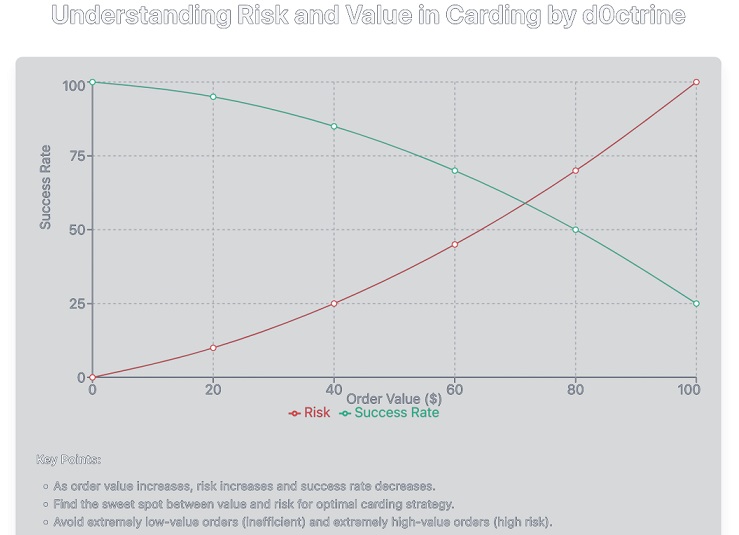
Some sites may require God-Tier proxies, others want clean Anti-Detect profiles. But on almost all sites, the higher the value of your order, the stricter the security becomes.
Your job, if you want to use your brain, is to find that sweet spot. You need to optimize for this reality if you want to be strategic in your carding and not just another script kiddie burning cards like toilet paper.
Beginner Pitfalls
Now that we’ve established the basic principle – higher value equals higher risk – let’s talk strategy. Understanding this opens up a whole new world of strategic carding. But before we get to the good stuff, let’s look at how beginners screw it up.
These idiots usually fall into two categories:
Idiots who go for the jugular straight away, trying to card the latest iPhone or a goddamn Rolex with their 414720. The result? A bunch of cancellations, banned accounts, and probably a nervous breakdown. It’s ambitious, but it’s also stupid as hell.
On the other hand, we have the cowards who are either afraid of getting caught or just don’t want to spend money on normal cards. They only card $5 gift cards, Spotify accounts, and Netflix accounts. Sure, they may have a high success rate, but at what cost? They spend more time setting up proxies than they do actually making a profit.
The key to carding is finding that sweet spot. You want to card smart, not too hot, not too cold, but just right. It’s about making a profit while minimizing risk.
Balancing Value and Risk
This isn’t some theory I pulled out of my ass after a night of drinking. It’s the distilled wisdom of years of carding, countless mistakes, and victories. This is your new bible, your carding roadmap.
What you’re looking at is the relationship between the value of an item and the risk of carding it. It's not quantum physics, but you'd be surprised how many idiots ignore this basic principle.
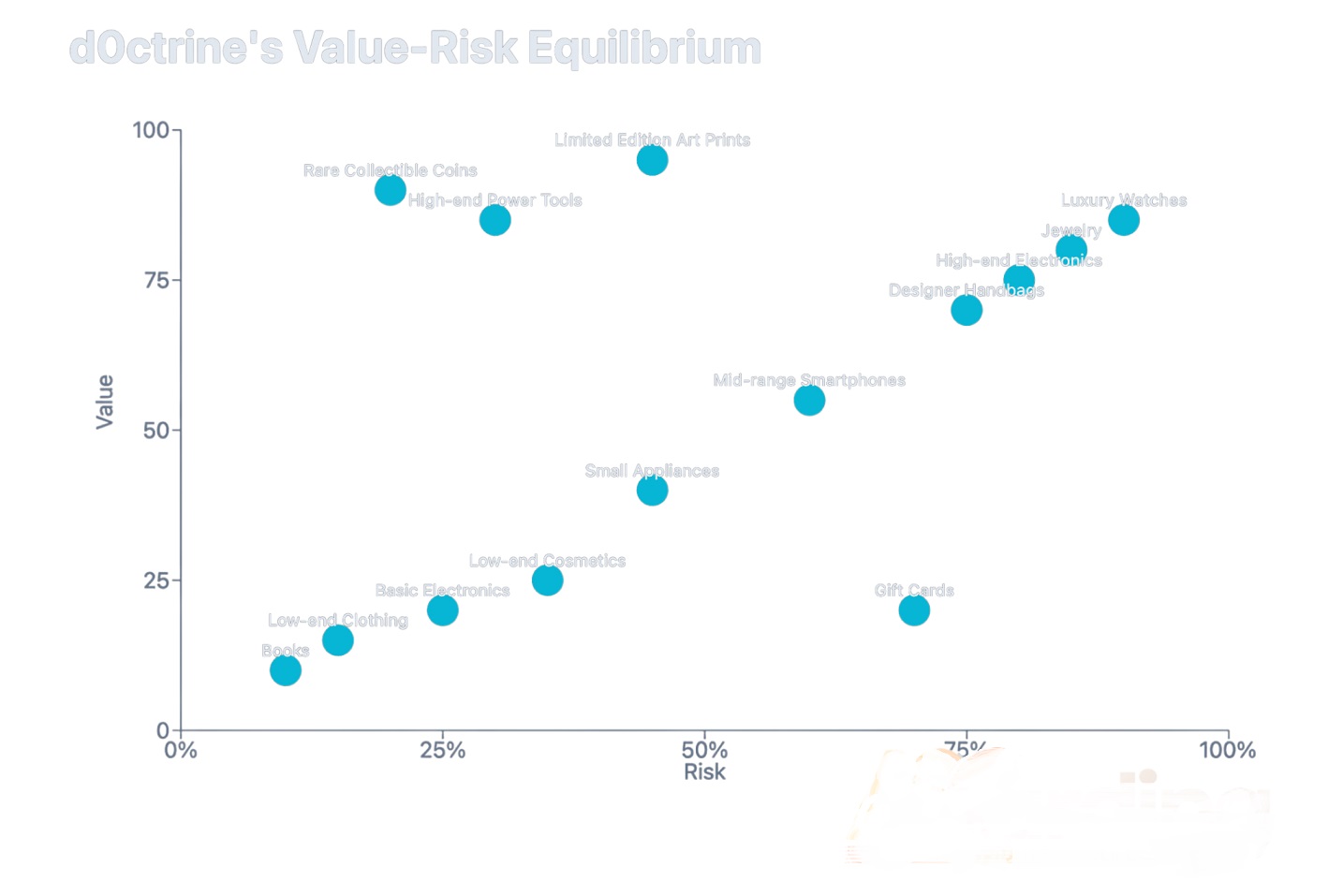
Let's break this down:
Of course, there are exceptions to this risk-value rule, and you should be on your guard. Low-risk, high-value items are the Holy Grail of carding — high-end power tools, limited edition art prints, rare collectible coins, and the like. They fly under the radar, but still command a hefty price tag.
On the other hand, avoid high-risk, low-cost crap like Liquid gift cards (Amazon, Walmart, whatever), gaming gift cards, and cryptocurrency. They may seem tempting, but they’re more likely to burn you than make you a profit. Noob carders flock to them, so their system is stricter than your girlfriend’s parents’. Anything with immediate resale value is usually more trouble than it’s worth.
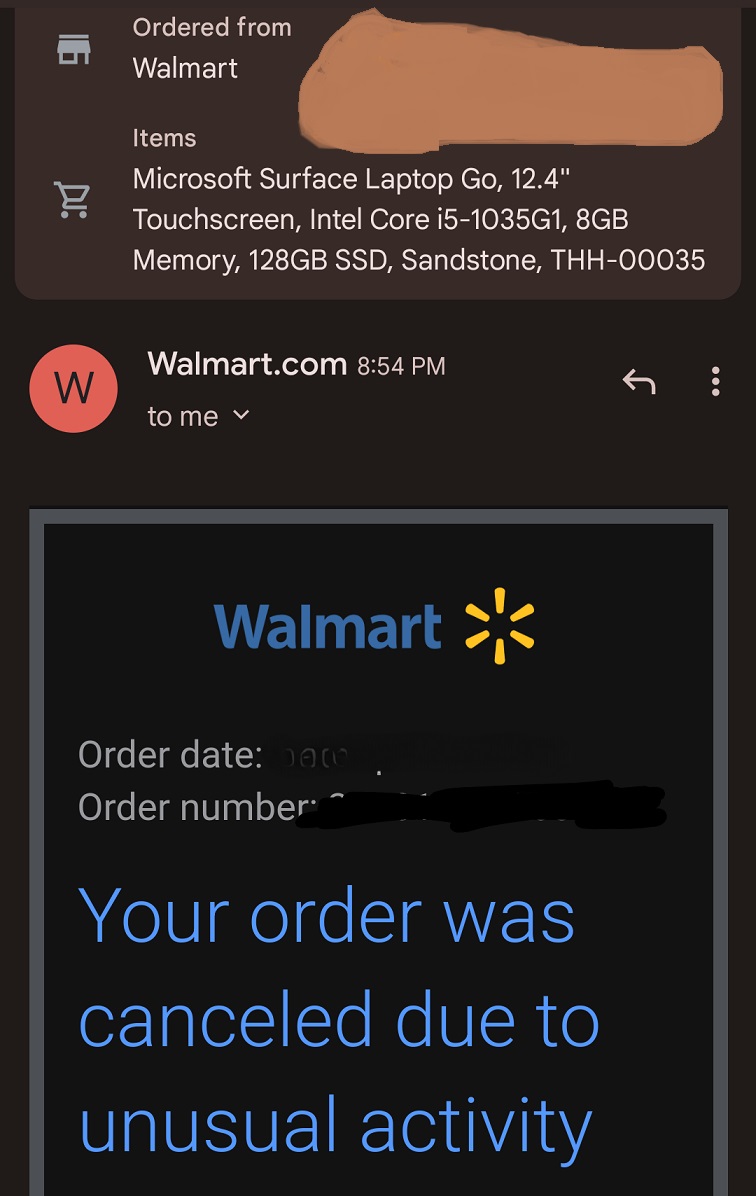
Adaptability is key. The sweet spot isn’t fixed — it moves, motherfucker. What works today is high risk tomorrow. You need to be like water, my friend. Go with the flow, always looking for that balance.
Look for things that are just starting to trend. They’re valuable enough to be worth your time, but haven’t been caught by the fraud teams yet. It’s like surfing — you want to catch the wave when it’s forming, not when it’s about to crash.
Remember, it’s not just the product itself. It’s the entire fucking ecosystem. The merchant, the time of year, even the day of the week can move where the product sits on that chart.
Black Friday? That expensive TV might slide into medium-risk territory because merchants are more concerned with volume than individual transactions. Tuesday at 3am? That’s when the fraud teams are at their lowest staffing levels, so you can try your luck a little higher up the value scale.
Value vs. Risk isn’t just a concept – it’s the fucking mindset of a SIGMA carder. Master it, and you’ll be playing 4D chess while other carders are still trying to figure out how to set up their chessboards.
Compounding Profits: The Long Game
Now that you understand the balance between value and risk, let’s talk about the real magic: compounding profits. It’s not just about scoring one big hit, it’s about building a fucking empire.
Picture this: Some idiots have been hammering away for weeks trying to knock off a Rolex. Meanwhile, the strategic carder is quietly hammering away at power tools every day. By the time that idiot finally gets his hands on his overpriced watch (if he ever does), our smart carder has already tripled the value of the Rolex with successful hits.
It’s not rocket science. Consistency beats luck every fucking time. Let’s break it down:
Hitting medium risk items means more wins, more often. It’s simple math, idiots.
Fewer failures means you’re not lighting up scam systems like a Christmas tree.
You’re constantly refining your technique instead of banging your head against high security walls.
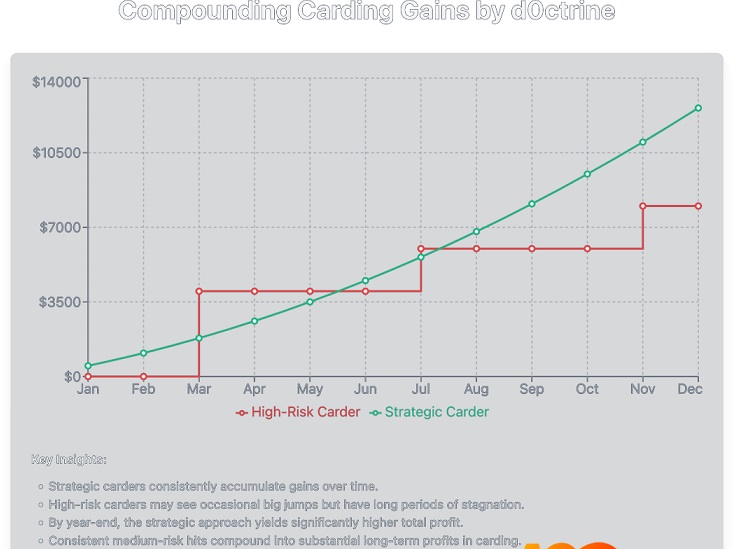
Now picture this shit over the course of a year. The high risk hunter might get a couple big points, sure. But our strategic player? They’re piling up wins day after day, week after week. It’s like compound interest, but for scams.
Think about it:
High risk player: Maybe 3-5 big points a year if they’re lucky.
Strategic player: Dozens of medium points every month, while continually expanding their operation.
By the end of the year, the strategic carder isn’t just ahead in profits; they’ve built a sustainable operation. They have the best cards, the best methods, and a shit ton of data on what works.
Remember, in this game, slow and steady doesn’t just win, it builds an empire while everyone else is trying to figure out how to tie their shoes.
Conclusion
Okay, let’s get to the point: balancing value and risk isn’t just theory, it’s your carding roadmap. Find the sweet spot between risk and value, look for those outliers, and be prepared to adapt. This is a strategy game, not just swinging your dick around with high-value items. In the coming days, we’ll be diving into the Strategic Carding series, where we’ll cover research methods for timing your shots.
So stay alert, and have your proxies ready. Lesson over.
In this series, we’re going to dive deep into the art of thinking like a carding master. I’m not here to hold your hand or spoon feed you step-by-step tutorials. This series is about rewiring your brain to approach carding like a chess grandmaster, not like a button-mashing pawn.
So sit back and relax. We’re about to take your carding game from checkers to 4D chess. Just remember: I’m here to teach you how to think, not what to think. Use the brain between your ears, and let’s be strategic.
Optimizing Value
Your job as a carder isn’t just to get free shit. It’s to optimize every move you make. Every cancelled order isn’t just a waste of resources; it’s time wasted. And in this game, time is more valuable than the cards you burn.
One way to increase your success rate is to be smart about the value of what you’re carding. Whether it’s digital goods or physical shit, there’s only one constant in carding: the risk of cancellation increases with the value of the item. This has been true since the beginning of carding — as prices rise, so does merchant paranoia.
Some sites may require God-Tier proxies, others want clean Anti-Detect profiles. But on almost all sites, the higher the value of your order, the stricter the security becomes.
Your job, if you want to use your brain, is to find that sweet spot. You need to optimize for this reality if you want to be strategic in your carding and not just another script kiddie burning cards like toilet paper.
Beginner Pitfalls
Now that we’ve established the basic principle – higher value equals higher risk – let’s talk strategy. Understanding this opens up a whole new world of strategic carding. But before we get to the good stuff, let’s look at how beginners screw it up.
These idiots usually fall into two categories:
Idiots who go for the jugular straight away, trying to card the latest iPhone or a goddamn Rolex with their 414720. The result? A bunch of cancellations, banned accounts, and probably a nervous breakdown. It’s ambitious, but it’s also stupid as hell.
On the other hand, we have the cowards who are either afraid of getting caught or just don’t want to spend money on normal cards. They only card $5 gift cards, Spotify accounts, and Netflix accounts. Sure, they may have a high success rate, but at what cost? They spend more time setting up proxies than they do actually making a profit.
The key to carding is finding that sweet spot. You want to card smart, not too hot, not too cold, but just right. It’s about making a profit while minimizing risk.
Balancing Value and Risk
This isn’t some theory I pulled out of my ass after a night of drinking. It’s the distilled wisdom of years of carding, countless mistakes, and victories. This is your new bible, your carding roadmap.
What you’re looking at is the relationship between the value of an item and the risk of carding it. It's not quantum physics, but you'd be surprised how many idiots ignore this basic principle.
Let's break this down:
- Low-risk, low-value zone (bottom left): This is where you'll find books, cheap clothes, and basic electronics. Sure, it's easy to read, but it's hardly worth the effort. It's like stealing pennies from a wishing well—yeah, you can do it, but why waste your damn time?
- High-Risk, High-Value Zone (top right): Welcome to the danger zone. Designer handbags, high-tech electronics, jewelry, and those fancy watches. The payoff is huge, but so is the chance of getting your virtual balls smashed. And as we explained earlier, too many cancellations means a waste of time and resources.
- The Golden Mean (the middle): This is where the real money is. Mid-range smartphones, small appliances — this golden mean is your gold mine. The risk is manageable, the rewards are juicy, and here’s the kicker: It’s much easier to chart a bunch of medium-risk items than one high-risk piece of crap. Add them up correctly, and you’ll make a bigger jackpot than any single luxury item, without setting off all the alarms in the system. Less noise, more profit.
Of course, there are exceptions to this risk-value rule, and you should be on your guard. Low-risk, high-value items are the Holy Grail of carding — high-end power tools, limited edition art prints, rare collectible coins, and the like. They fly under the radar, but still command a hefty price tag.
On the other hand, avoid high-risk, low-cost crap like Liquid gift cards (Amazon, Walmart, whatever), gaming gift cards, and cryptocurrency. They may seem tempting, but they’re more likely to burn you than make you a profit. Noob carders flock to them, so their system is stricter than your girlfriend’s parents’. Anything with immediate resale value is usually more trouble than it’s worth.
Adaptability is key. The sweet spot isn’t fixed — it moves, motherfucker. What works today is high risk tomorrow. You need to be like water, my friend. Go with the flow, always looking for that balance.
Look for things that are just starting to trend. They’re valuable enough to be worth your time, but haven’t been caught by the fraud teams yet. It’s like surfing — you want to catch the wave when it’s forming, not when it’s about to crash.
Remember, it’s not just the product itself. It’s the entire fucking ecosystem. The merchant, the time of year, even the day of the week can move where the product sits on that chart.
Black Friday? That expensive TV might slide into medium-risk territory because merchants are more concerned with volume than individual transactions. Tuesday at 3am? That’s when the fraud teams are at their lowest staffing levels, so you can try your luck a little higher up the value scale.
Value vs. Risk isn’t just a concept – it’s the fucking mindset of a SIGMA carder. Master it, and you’ll be playing 4D chess while other carders are still trying to figure out how to set up their chessboards.
Compounding Profits: The Long Game
Now that you understand the balance between value and risk, let’s talk about the real magic: compounding profits. It’s not just about scoring one big hit, it’s about building a fucking empire.
Picture this: Some idiots have been hammering away for weeks trying to knock off a Rolex. Meanwhile, the strategic carder is quietly hammering away at power tools every day. By the time that idiot finally gets his hands on his overpriced watch (if he ever does), our smart carder has already tripled the value of the Rolex with successful hits.
It’s not rocket science. Consistency beats luck every fucking time. Let’s break it down:
Hitting medium risk items means more wins, more often. It’s simple math, idiots.
Fewer failures means you’re not lighting up scam systems like a Christmas tree.
You’re constantly refining your technique instead of banging your head against high security walls.
Now picture this shit over the course of a year. The high risk hunter might get a couple big points, sure. But our strategic player? They’re piling up wins day after day, week after week. It’s like compound interest, but for scams.
Think about it:
High risk player: Maybe 3-5 big points a year if they’re lucky.
Strategic player: Dozens of medium points every month, while continually expanding their operation.
By the end of the year, the strategic carder isn’t just ahead in profits; they’ve built a sustainable operation. They have the best cards, the best methods, and a shit ton of data on what works.
Remember, in this game, slow and steady doesn’t just win, it builds an empire while everyone else is trying to figure out how to tie their shoes.
Conclusion
Okay, let’s get to the point: balancing value and risk isn’t just theory, it’s your carding roadmap. Find the sweet spot between risk and value, look for those outliers, and be prepared to adapt. This is a strategy game, not just swinging your dick around with high-value items. In the coming days, we’ll be diving into the Strategic Carding series, where we’ll cover research methods for timing your shots.
So stay alert, and have your proxies ready. Lesson over.