

If you’ve been riding the Bitcoin and Monero mixer wave — as I explained in “Bitcoin Privacy Guide” and “Carder’s Handbook: Monero Basics” — you already know that your cryptocurrency is supposed to disappear without a damn trace. Enter TornadoCash, the largest Ethereum mixer that entangles your ETH in a vortex of anonymity. It’s a hardcore tool that, when used with proper OPSEC, can add an extra layer of protection to your digital holdings. But let’s be clear: No system is invincible if you screw up your paranoia.
What is TornadoCash?

TornadoCash is a decentralized mixer built on immutable Ethereum smart contracts. Think of it as a digital washing machine for your ETH, only instead of washing your clothes, it wipes your transactions clean. By forcing you to deposit fixed amounts (eg: 1, 10, or 100 ETH), it pools your funds with the money of countless other degenerates, making it virtually impossible to track which output belongs to whom. If you’ve dug through the Bitcoin Privacy Guide, you already understand how important it is to mix your transactions. TornadoCash takes this concept and runs with it, allowing you to withdraw to a new wallet so that your previous movements remain as mysterious as your deepest secrets.
Anonymous Coins
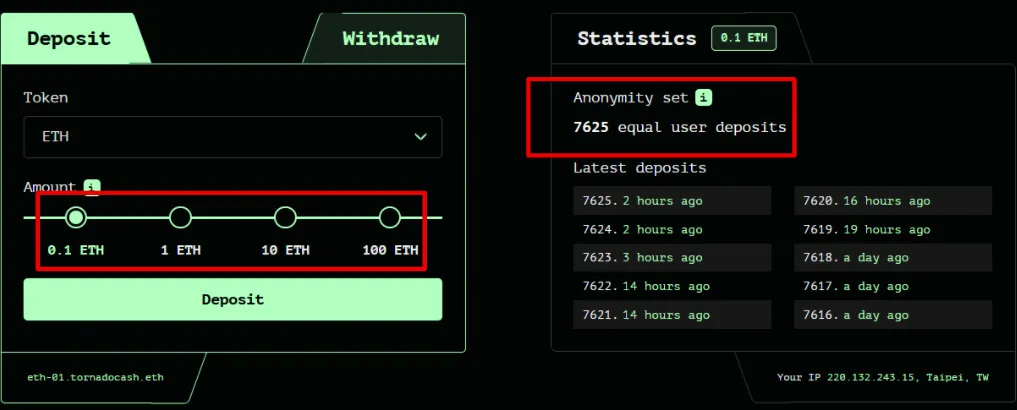
When you deposit ETH into TornadoCash, you’re not just sending funds to a random address — you’re throwing them into a common pot. This "anonymous set" is your new best friend, a chaotic mass of coins from dozens of users, collected together, like the mixers I talked about earlier, the only difference is that, unlike mixers, TornadoCash is a decentralized mixer, meaning it is not owned by one person, but is permanently located on the Ethereum blockchain.
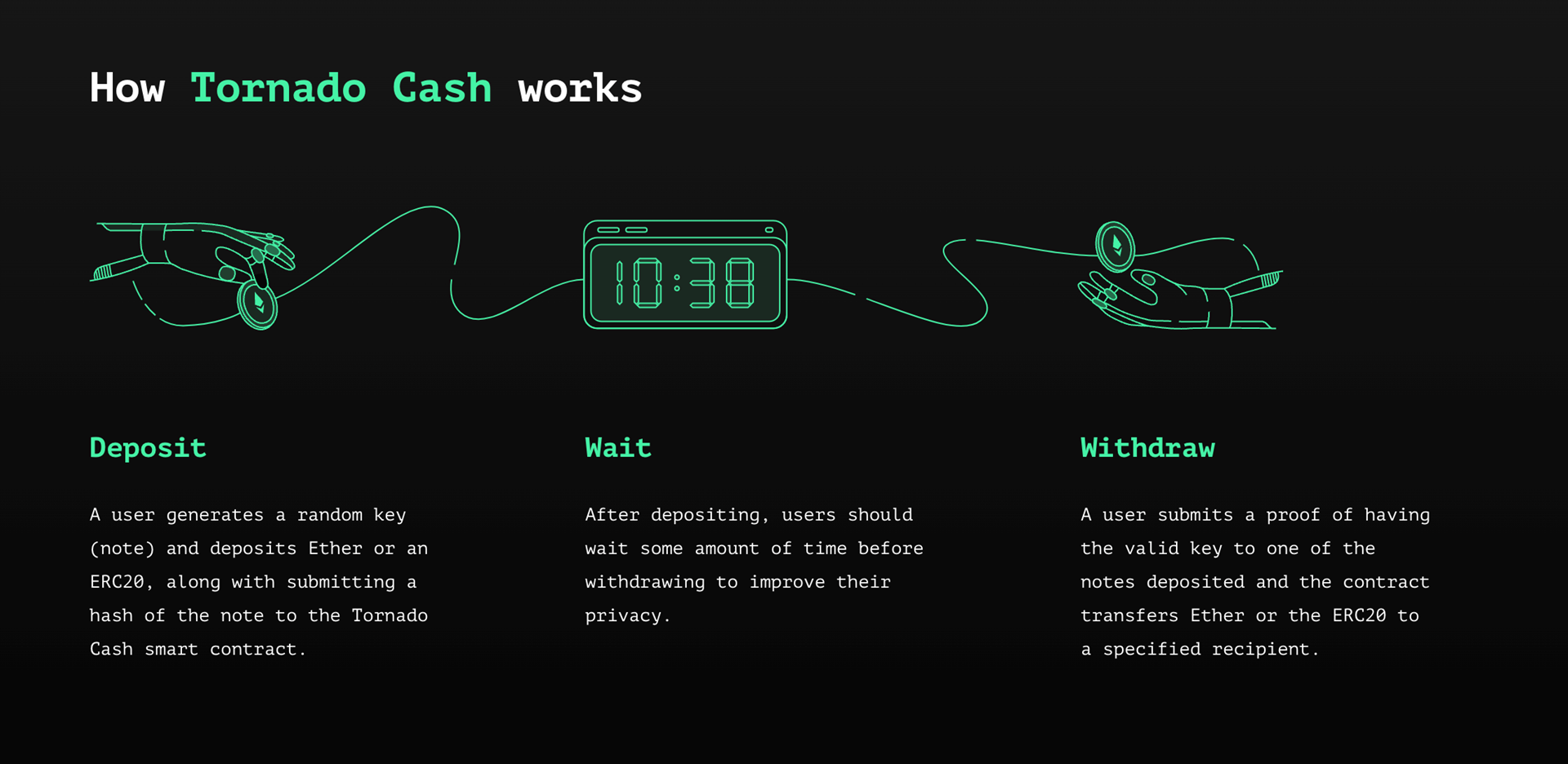
The system maintains separate “pools” for different deposit amounts — there’s a pool for 1 ETH deposits, another for 10 ETH, and so on. When you deposit your funds, you join others in that particular pool, making it exponentially harder to track who’s withdrawing what. The larger the pool’s anonymity set (the total amount of funds deposited), the better your privacy.
Once you deposit your funds into the TornadoCash contract, it generates a cryptographic proof — a secret deposit note — that’s your golden ticket to getting your funds back later. This note separates your initial deposit from your final withdrawal.
Using advanced zero-knowledge proofs (ZK-SNARKS for the tech-curious), TornadoCash verifies that you deposited the correct amount without revealing any details about your deposit. The smart contract trusts the math, but never spills the beans. It’s the same magic we used with Moneros stealth addresses — only now it’s on Ethereum.
When it’s time to withdraw, you use your secret note to withdraw your ETH to any address. This means the wallet that cashes out doesn’t have to be connected in any way to the one that made the deposit. Your coins reappear like a ghost, leaving no trace.
A Word of Caution
In 2022, OFAC came down hard on TornadoCash, confiscating domains and even arresting developers. Their lame excuse was that TornadoCash was facilitating billions in illegal transactions. All this government stance did was spawn a flood of scam interfaces designed to steal your crypto.
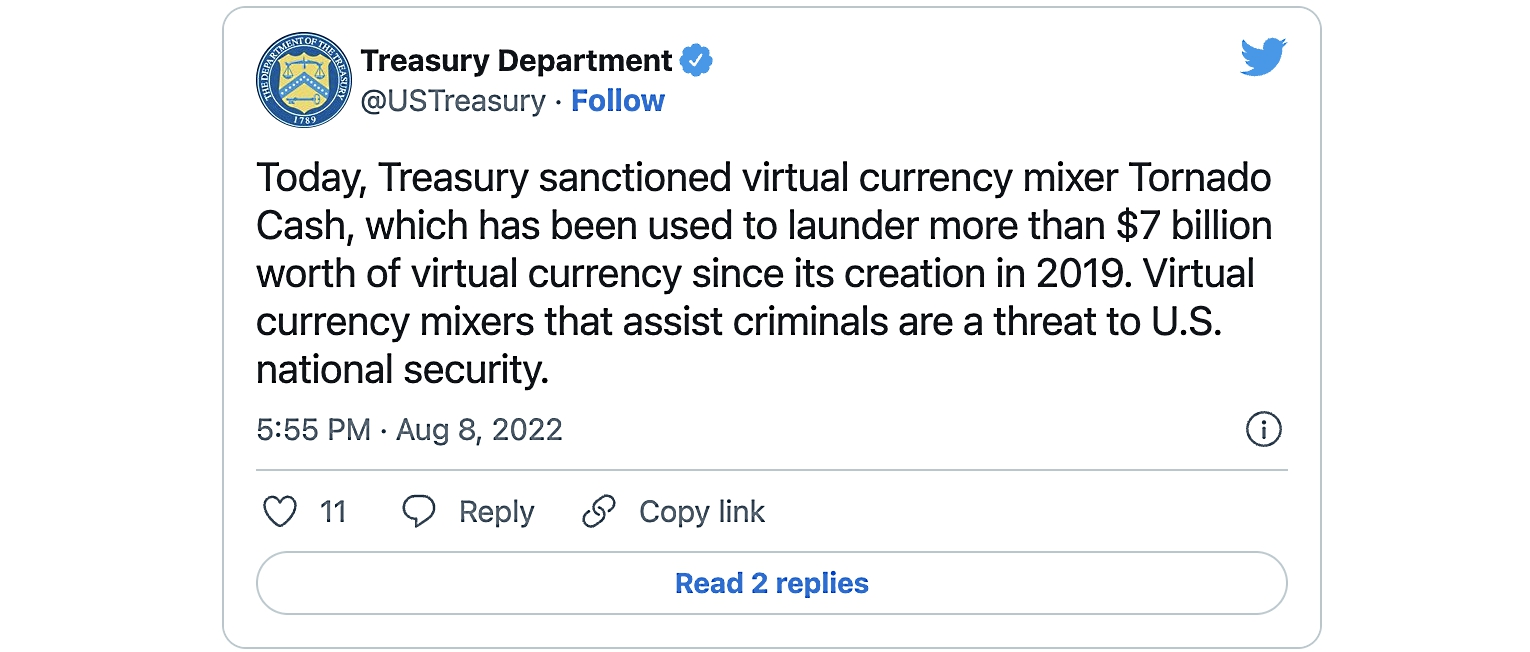
What they don’t understand is this: TornadoCash is not a website or a service — its mathematical code is permanently embedded in the Ethereum blockchain. The government’s attempts to shut it down exposed their fundamental misunderstanding. You can’t erase smart contracts, any more than you can erase the math itself.
The legitimate protocol is located at 0xd90e2f925DA726b50C4Ed8D0Fb90Ad053324F31b. Interact with that contract or its trusted proxies, and you’re using the real TornadoCash. Scammers can create all the fake interfaces they want, and the government can confiscate all the domains they want, but the underlying protocol remains intact, unchanged, and working to this day. It works so well that the contract currently holds $568,000,000 in funds.

This isn’t to say it’s all rainbows and unicorns: While your transactions are mathematically private (there’s no way to link your deposit to your withdrawal, let alone prove they’re from the same person), any funds withdrawn from TornadoCash are marked as “authorized” on most exchanges. Every major analytics platform flags these coins. Sending funds withdrawn from TornadoCash directly to a centralized KYC exchange is digital suicide, especially in the US. The smart approach is to keep your withdrawn funds completely separate from centralized platforms, or at least use them on-chain before withdrawing.
Process
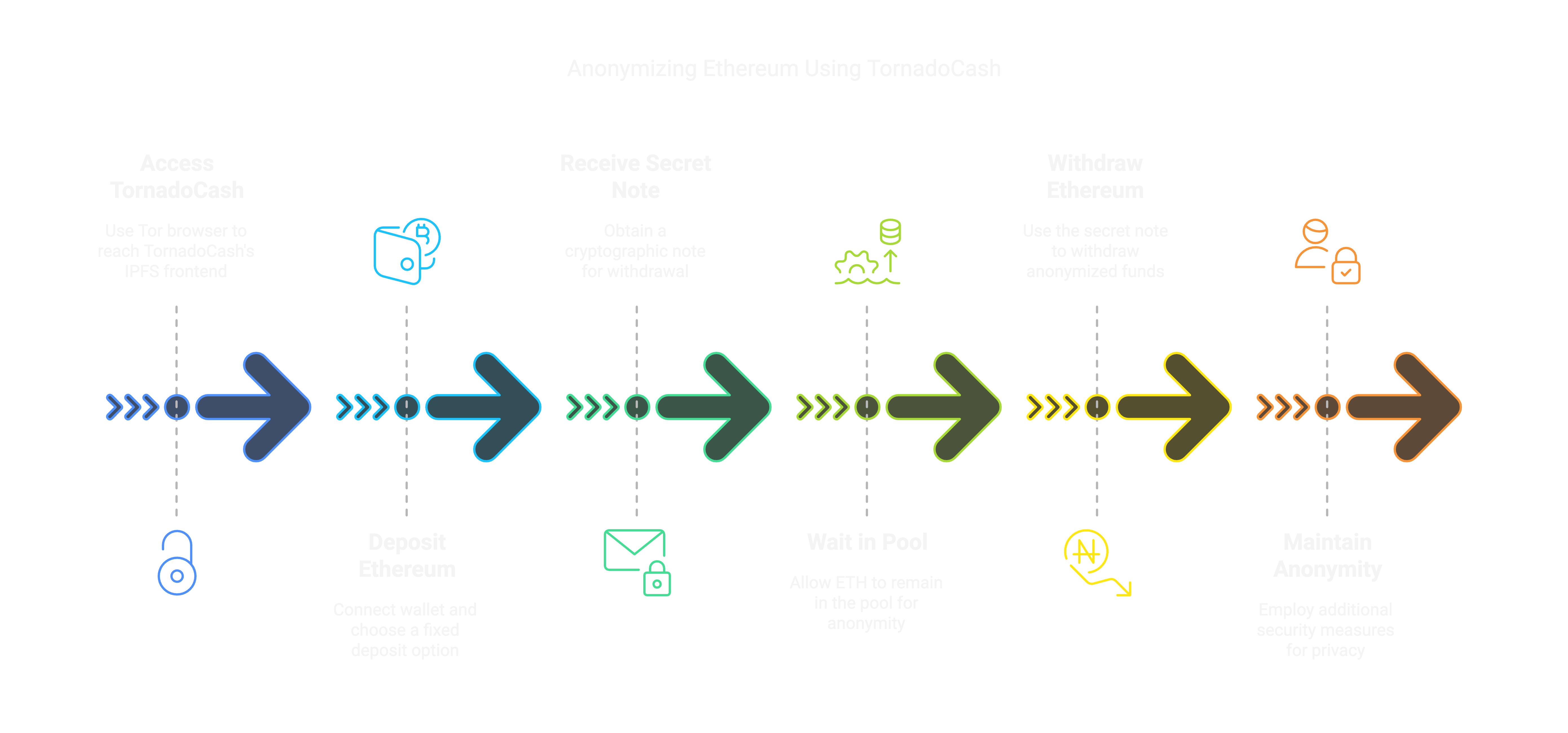
Here's how you can anonymize your ETH via TornadoCash:
But I don’t have ETH!
“But I don’t use ETH!” I hear you scream. It doesn’t matter. TornadoCash isn’t just for Ethereum — it’s an all-purpose cleaner for any cryptocurrency you hold.
Remember our discussion about Monero about creating untraceable paths? TornadoCash fits that strategy perfectly. Your Bitcoin, Monero, Litecoin, or whatever coin you’re carrying can get a refresh in the Ethereum mix pool.
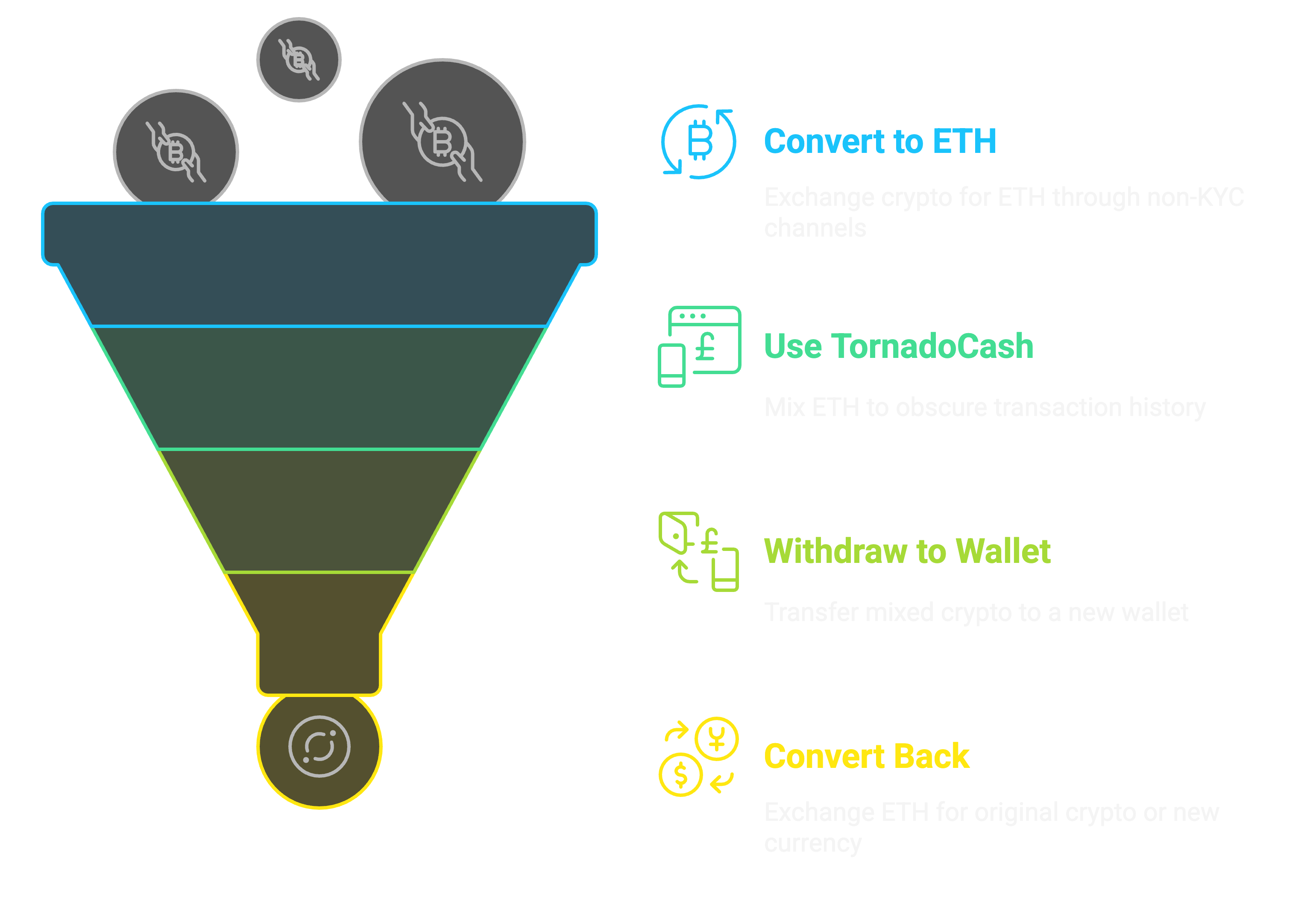
The beauty of this approach is its simplicity: convert your crypto to ETH via any KYC-free exchange, run it through TornadoCash, and let it bake. After a few days, withdraw to a new wallet and convert back to any crypto you like.
Each conversion adds another layer of confusion, like a Russian nesting doll of privacy. By the time your funds have completed their journey, the original trail will have gone cold, and no one will be able to connect the dots. The blockchain equivalent of your coins going into witness protection.
This method actually works better than direct mixing in many cases. Why? Because you’re not just mixing coins — you’re crossing chains and swapping currencies, leaving false trails across multiple networks.
Be careful, not apologetic
TornadoCash is not a magic wand, no technology is completely foolproof. But when used correctly, OPSEC is a powerful tool for anonymizing your Ethereum transactions. It breaks the direct link between deposit and withdrawal, creating a hard-to-trace path for your funds.
Just don’t be overconfident. As always, the rules of the game remain the same: strengthen your defenses, be unpredictable, and never assume that any system will protect you if you neglect your own operational security. Be smart, keep your digital footprint to a minimum, and remember that in our world, your freedom is as secure as your ability to leave no trace.
Now go mix those coins and keep your ass covered.
(c) Contact the author here: d0ctrine
What is TornadoCash?
TornadoCash is a decentralized mixer built on immutable Ethereum smart contracts. Think of it as a digital washing machine for your ETH, only instead of washing your clothes, it wipes your transactions clean. By forcing you to deposit fixed amounts (eg: 1, 10, or 100 ETH), it pools your funds with the money of countless other degenerates, making it virtually impossible to track which output belongs to whom. If you’ve dug through the Bitcoin Privacy Guide, you already understand how important it is to mix your transactions. TornadoCash takes this concept and runs with it, allowing you to withdraw to a new wallet so that your previous movements remain as mysterious as your deepest secrets.
Anonymous Coins
When you deposit ETH into TornadoCash, you’re not just sending funds to a random address — you’re throwing them into a common pot. This "anonymous set" is your new best friend, a chaotic mass of coins from dozens of users, collected together, like the mixers I talked about earlier, the only difference is that, unlike mixers, TornadoCash is a decentralized mixer, meaning it is not owned by one person, but is permanently located on the Ethereum blockchain.
The system maintains separate “pools” for different deposit amounts — there’s a pool for 1 ETH deposits, another for 10 ETH, and so on. When you deposit your funds, you join others in that particular pool, making it exponentially harder to track who’s withdrawing what. The larger the pool’s anonymity set (the total amount of funds deposited), the better your privacy.
Once you deposit your funds into the TornadoCash contract, it generates a cryptographic proof — a secret deposit note — that’s your golden ticket to getting your funds back later. This note separates your initial deposit from your final withdrawal.
Using advanced zero-knowledge proofs (ZK-SNARKS for the tech-curious), TornadoCash verifies that you deposited the correct amount without revealing any details about your deposit. The smart contract trusts the math, but never spills the beans. It’s the same magic we used with Moneros stealth addresses — only now it’s on Ethereum.
When it’s time to withdraw, you use your secret note to withdraw your ETH to any address. This means the wallet that cashes out doesn’t have to be connected in any way to the one that made the deposit. Your coins reappear like a ghost, leaving no trace.
A Word of Caution
In 2022, OFAC came down hard on TornadoCash, confiscating domains and even arresting developers. Their lame excuse was that TornadoCash was facilitating billions in illegal transactions. All this government stance did was spawn a flood of scam interfaces designed to steal your crypto.
What they don’t understand is this: TornadoCash is not a website or a service — its mathematical code is permanently embedded in the Ethereum blockchain. The government’s attempts to shut it down exposed their fundamental misunderstanding. You can’t erase smart contracts, any more than you can erase the math itself.
The legitimate protocol is located at 0xd90e2f925DA726b50C4Ed8D0Fb90Ad053324F31b. Interact with that contract or its trusted proxies, and you’re using the real TornadoCash. Scammers can create all the fake interfaces they want, and the government can confiscate all the domains they want, but the underlying protocol remains intact, unchanged, and working to this day. It works so well that the contract currently holds $568,000,000 in funds.
This isn’t to say it’s all rainbows and unicorns: While your transactions are mathematically private (there’s no way to link your deposit to your withdrawal, let alone prove they’re from the same person), any funds withdrawn from TornadoCash are marked as “authorized” on most exchanges. Every major analytics platform flags these coins. Sending funds withdrawn from TornadoCash directly to a centralized KYC exchange is digital suicide, especially in the US. The smart approach is to keep your withdrawn funds completely separate from centralized platforms, or at least use them on-chain before withdrawing.
Process
Here's how you can anonymize your ETH via TornadoCash:
- 1. Access TornadoCash:
– Launch the Tor browser and go to the TornadoCash Twitter page ( https://x.com/tornadocash ).
– Click on the IPFS interface link hosted there. Since their main domains were seized, this is the fastest and most reliable way to get to a current mirror.
– If you want the best, you can always fork the interfaces and run your own local instance.
– Double, even triple check that you are on a verified account (look for a blue checkmark and at least 60k followers). The URL you go to is almost certainly an IPFS link – a decentralized network – and you should be able to access it through TOR.
- 2. Deposit:
– Connect your Ethereum wallet once you are on the IPFS frontend.
– Choose one of the available fixed deposit options. TornadoCash only accepts pre-defined amounts (e.g. 1, 10, or 100 ETH), so don’t even think about transferring outside the script. Stick to the options provided so that your deposit fits easily into the anonymity set. - 3. Receive your secret note:
- Once your deposit is confirmed, you will receive a secret cryptographic proof - a note, which is your only key to withdraw your funds later.
- Guard this note with your life; if it is lost, you will also lose your funds.
- 4. Wait:
– Let your ETH cool down in the pool. Longer wait times mean more anonymity. Patience is not for the faint of heart; it separates the pros from the clueless.
– As mentioned in the Carder’s Handbook: Monero Basics, timing is of the essence. Don’t be the dumbass who withdraws too quickly, exposing his transaction trail. - 5. Withdrawal of funds:
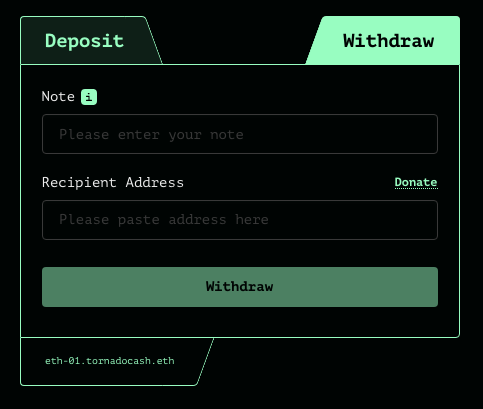
– When you’re ready to get your ETH back, go back to the IPFS frontend.
– Send your secret note to the withdrawal function.
– Boom – your funds will reappear in a new, clean wallet address that has nothing to do with the original deposit. - 6. Stay Stealthy:
– Always withdraw to a wallet isolated from your personal identity – learn from the cautionary tales in The Carder’s Handbook: Monero Basics
– Take extra OPSEC measures: run your own Ethereum node, route all traffic through Tor, and use as many hidden layers as possible to avoid any government lists.
But I don’t have ETH!
“But I don’t use ETH!” I hear you scream. It doesn’t matter. TornadoCash isn’t just for Ethereum — it’s an all-purpose cleaner for any cryptocurrency you hold.
Remember our discussion about Monero about creating untraceable paths? TornadoCash fits that strategy perfectly. Your Bitcoin, Monero, Litecoin, or whatever coin you’re carrying can get a refresh in the Ethereum mix pool.
The beauty of this approach is its simplicity: convert your crypto to ETH via any KYC-free exchange, run it through TornadoCash, and let it bake. After a few days, withdraw to a new wallet and convert back to any crypto you like.
Each conversion adds another layer of confusion, like a Russian nesting doll of privacy. By the time your funds have completed their journey, the original trail will have gone cold, and no one will be able to connect the dots. The blockchain equivalent of your coins going into witness protection.
This method actually works better than direct mixing in many cases. Why? Because you’re not just mixing coins — you’re crossing chains and swapping currencies, leaving false trails across multiple networks.
Be careful, not apologetic
TornadoCash is not a magic wand, no technology is completely foolproof. But when used correctly, OPSEC is a powerful tool for anonymizing your Ethereum transactions. It breaks the direct link between deposit and withdrawal, creating a hard-to-trace path for your funds.
Just don’t be overconfident. As always, the rules of the game remain the same: strengthen your defenses, be unpredictable, and never assume that any system will protect you if you neglect your own operational security. Be smart, keep your digital footprint to a minimum, and remember that in our world, your freedom is as secure as your ability to leave no trace.
Now go mix those coins and keep your ass covered.
(c) Contact the author here: d0ctrine